As mentioned in part one, the Header section of our spreadsheet contains some important metadata on the texts in the control and the other extant witnesses. Some of the fields contain dropdown boxes (e.g. Tempo and Key signature) or tick boxes (e.g. Ornamentation); the rest of the fields are free text entry (they are left empty if the particular field does not apply to the witness). This post explains the Header section and its rows in a little more detail to help understand how and why we recorded this data.
Title
This field can contain a descriptor (‘Sonata’), a number, a composer (NB: Scarlatti is sometimes referred to as e.g. Escarlati) or any other indicator. These are transcribed as they appear on the page; generally we avoid including additions by later hands such as librarians or later collectors.
Examples include:
- Sonata de Scarlati
- 5a Sonata (NB: Superscript may also be recorded using conventions such as 5.a)
- 24
Tempo
This is a dropdown box consisting of (practically) all the tempo indications found in the control. Abbreviated tempo indications such as Ande or Allo are generally treated as Andante or Allegro respectively, and (archaic) misspellings in the witnesses may not always be recorded (common examples are doubled consonants such as Cantabbile or the grave accent in the Italian è).
Clefs other than G2 and F4
This cell is used to record appearances of clefs other than G2 and F4 (C1, C3, and C4).
Key signature
This dropdown box is used to record the initial key signature (number of sharps/flats). Note that the number of sharps or flats in the initial key signature may not be the same as modern conventions for that key. Changes of key signature may have been recorded in the Other observations cell.
Time signature
This dropdown box is used to record the (combination of) time signature(s).
Sonata not bipartite
This box is ticked if the sonata is not in the usual two-part form (for example a Fugue).
Number of bars
This cell is used to record the number of bars for each part (or section) in the form 39+40. There are several special cases:
- Upbeats are usually not counted as part of the bar count;
- An incomplete bar at the end of a part may be judged to belong to either the first or second part. Where this might be ambiguous we use the same way of counting for all witnesses;
- In Fugues and similar pieces only one number is given for the entire piece;
- In multi-movement sonatas bar counts are given for each part (e.g.
26+221+18+28+12+20for K88).
Range
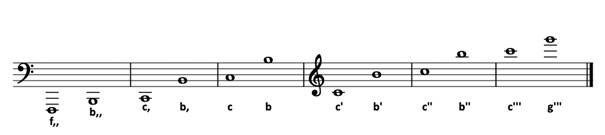
We record the lowest and highest note in the form f,, - g''' according to the LilyPond conventions:
Hand signs
The relevant combination of hand signs is selected from the dropdown box.
Repeat signs
The appropriate form of repeat signs used at the first and second ending is selected from the dropdown box. Generally, we select either ‘End double bar with repeat’ or ‘End double bar without repeat’ and include any other markings (e.g. Volti, Segue) in Other observations, but our dataset contains multiple approaches to this cell. In Fugues and similar pieces only one ending is selected.
Note that great curves are curved lines drawn either above or below staves (or both), that are not to be interpreted as ties or slurs. Great curves are most often (but not always!) used at endings where a first and second ending are required. The curves appear surrounding the penultimate bar before the double barline, the bar to be suppressed when the repeat is played. The clearest example of the function of the great curve appears in the Venice/Parma copies of K440. Their use is common in eighteenth century keyboard music (e.g. Goldberg Variations) (Sheveloff 1970Sheveloff, Joel Leonard. 1970. ‘The Keyboard Music of Domenico Scarlatti: A Re-Evaluation of the Present State of Knowledge in the Light of the Sources’. PhD dissertation, Brandeis University. , pp. 279-91).
Internal repetitions
This cell is used to record where individual bars or short passages are marked to be repeated (other than at the endings of the first or second parts). Examples include:
- Use of the word ‘bis’ in French and German copies;
- Variations and translations of the word ‘repeat’;
- Silcrow signs (§) on barlines;
- Dotted lines enclosing a few bars.
Articulation
This cell is used to record articulation such as slurs or staccato where they appear. Note that slurring over grace or small notes (acciaccatura/appoggiatura) is not recorded.
Dynamics
This cell is used to record how dynamics are notated. Dynamics are generally found in later editions (such as Clementi 1 and its copies) but also appear in some manuscript witnesses (such as K6 in Berlin 19680 and Montecassino 6-E).
Ornamentation
Ornamentation in Scarlatti can take on many shapes and forms. The relevant box is ticked if the witness contains at least one of a wavy-line trill or tr. Examples of all ornamentation found in extant witnesses of Scarlatti’s keyboard music are given in the table below (in the Other ornaments section).
Acciaccaturas and appoggiaturas
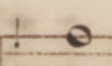
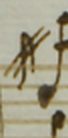
These tick boxes are used to record whether or not at least one acciaccatura (slashed grace note) or appoggiatura (grace note) is present. Note that there may have been no difference in execution for these forms: we merely record their appearance on the page. The following tables show forms of appoggiaturas and acciaccaturas:
| K522, Venice 13 | K522, Venice 13 | K109, Parma 3 | K109, Venice 1749 | K102, Venice 1749 |
|---|---|---|---|---|
 |
 |
 |
 |
 |
app4 |
app8 |
app16 |
app32 |
app64 |
| K522, Venice 13 | K48, Barcelona M1964 |
|---|---|
 |
 |
acc8 |
acc16 |
Note that to distinguish between one and two slashes we use either acc8 or acc16. As mentioned, in practice there may have been no difference between how these were executed: the notation used to describe these forms is simply used to distinguish between their appearance on the page. A copyist may, for instance, at one point use the app16 form for a semiquaver (16th) grace note and at different times use the acc8 form to notate (perhaps) exactly the same thing.
Tremulo
This tick box is used to record appearances of the tremulo ornament.
Other ornaments
This cell is used to record all other ornaments not covered by the tick boxes. Examples include mordents, slides, turns, etc. A table of ornaments found in the Scarlatti witnesses is given below:
| Type of ornament | Example | Notation |
|---|---|---|
| Trill (wavy line) | 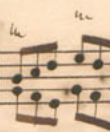 |
trill(K492, Parma 14) |
| Trill (tr) |  |
tr(K37, Roseingrave) NB: the single letter t is also considered a tr |
| Mordent |  |
mordent(K522, New York Cary) |
| Slide |  |
slide(K109, Venice 1749) |
| Double suspension | 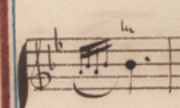 |
dblsus(K489, Venice 12) |
| Tremulo |  |
trem(K128, Parma 2) |
| Turn | 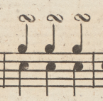 |
turn(K380, Clementi 1 (transposed)) |
| Inverted turn | 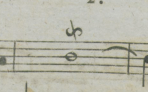 |
invturn(K373, Birchall) NB: (inverted) turns may also appear in written-out form |
| Double appoggiatura | 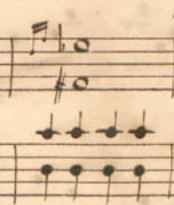 |
dblapp(K503, Parma 14) |
| Line of dots | 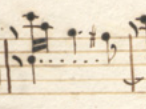 |
lineofdots(K115, Venice 1749) |
| Long wavy line |  |
longwavyline(K109, Parma 3) |
Note that both the line of dots and long wavy lines may not be ornaments; they could indicate something else (for example overholding).
Other observations
This cell is used to record any other indications that appear in the witness which are not covered by the other cells in the Header. There is also room here for observations of interest. Examples include:
-
- Written indications (e.g. mutandi (i deti) (change the fingers), which also may be spelled as mutanti (i det(t)i) or appear in abbreviated form (muta));
- Indications at first and second endings (e.g. Volti);
- Fermatas;
- Indications in the margins (such as numbers or text added by either the copyist or librarians);
- Copyist’s signatures;
- Directs;
- Or any other markings of interest.
Bars section
Part three of the User Manual provides more information and examples of the variant notation used in the Bars section.
Jasper van der Klis, October 2025