The Bars section consists of one row for each bar in the control. After a note-by-note comparison of each bar in the witness with the control, we either:
- Leave the cell empty if the bar in the witness is identical to that in the control; or
- Enter the variant reading(s) in the corresponding cell for that witness.
The expectation was that the majority of the cells remained empty since the witnesses are, in principle, copies of the same pieces of music. We found that of the c315,000 cells just over 85,000 cells contained at least one variant (approximately 27% of the bars). While the bars cells are essentially free text entry, we did require the input to be consistent and machine-readable which meant certain conventions had to be adhered to.
The general form of our variant notation is:
- The position in the bar (counted in vertical sound events);
- The relevant note on that position (to avoid ambiguity);
- A square closing bracket and space (
]); - The variant reading in the witness.
Examples of variant categories and notation
Pitch
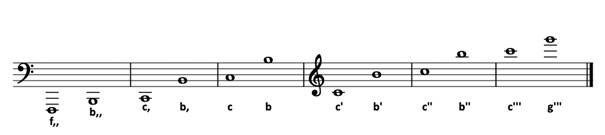
Figure 1. LilyPond pitch conventions
As mentioned in part two (Header), we use the LilyPond conventions for pitch, and used numbers to indicate note values. Some examples:
c'4: a crotchet (quarter note) middle Cb2: a minim (half note) a semitone below middle Cg'''16: a semiquaver (sixteenth note) G, typically the highest note used in Scarlatti’s late sonatas
Rests
For rests we use r followed by its value if necessary. For example: r4. would be a dotted crotchet rest.
Accidentals
sharp, flat, or natural. Double accidentals are similarly spelled out; for example doublesharp.
Hand signs
For hand signs we use capital letters M, D, L, R, and G (Manca, Dritta; Left, Right; Gauche, Droite).
Dynamics
Generally these are spelled out (piano, forte) but some abbreviations (cresc, dim), depending on the witness, are also accepted. Since placement of these markings can be quite ambiguous, we generally link their placement to the closest note in the bar.
Accents and expression
We prefer the abbreviations used in the witness (rit, rinf). Like for dynamics, placement of these markings can be quite ambiguous; we generally link their placement to the closest note in the bar.
Tuplet signs
We spell out tripletsign or sextupletsign.
Slurs and ties
Either slur or tie. It is sometimes difficult to determine exactly how long a slur is, which is why we only specify what note it starts from. Similarly, ties may be positioned differently in two witnesses even if the expected execution is likely to be the same. In these cases we have attempted to record any notational differences as accurately as possible.
Grace notes
As we mentioned in the Header section, there may have been no difference in execution for these forms: we merely record their appearance on the page. Refer to the table in part two of the User Manual (Header section) for examples of grace notes in the Scarlatti witnesses.
Ornaments and other indications
Refer to the table in part two of the User Manual (Header section) for examples of ornaments in the Scarlatti witnesses.
Multiple stems for the same pitch
Occasionally, notes of the same pitch might have more than a single stem (for instance, a concurrent soprano/alto crotchet bflat'). The two possibilities are:
- The note values of the concurrent notes are different (e.g. one quaver and one crotchet
c); - The note values of the concurrent notes are the same (e.g. two quavers
c).
In the first situation we refer to the pitch and its note value and whether it is present or absent in the witness: for example, 1c8] 0 for absence of the quaver c.
In the second situation we refer to the stem that is present or absent on the relevant pitch using the notation upstem (for upward stems) or downstem (for downward stems): for example, 1c] +upstem.
Plural forms
Occasionally we use plural forms to efficiently capture differences between the control and a witness. For our purposes we have limited these to ornaments, grace notes, tuplet signs, slurs and ties, and fermatas.
Recording variants
Recording and understanding variants correctly is a three-step process:
- First, identify the relevant note and position in the control text and the variant reading in the witness;
- Having identified the note and position, put it in the cell for that bar in that witness followed by a closing square bracket and a space (
]); - Finally, finish the variant notation by recording the variant reading.
Any further variants in the same bar are separated by semi-colons with a single space on both sides ( ; ).
Examples of incorrect notation:
7a8b9c] 7b8c9d
7a] +natural +tie
These notations are incorrect: we record each variant separately, even if multiple variants occur on the same note.
Correct forms:
7a] b ; 8b] c ; 9c] d
7a] +natural ; 7a] +tie
Special case: added notes between vertical sound events in the control
On rare occasions it may happen that notes have been added between vertical sound events in the control. An example from K545 is given below:
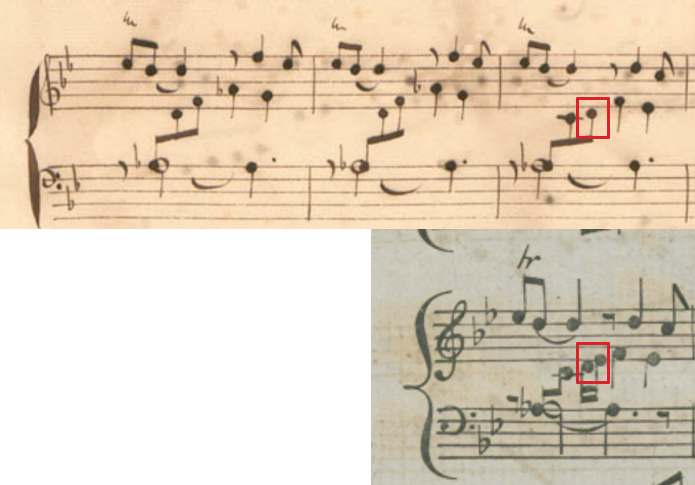
Figure 2. Example of added note between vertical sound events in K545 (Birchall)
This can be resolved in the following manner:
- Our notation essentially assumes that any given position, for example
4, is the same as4.0; - Therefore, any added event should start from 4.1. What happens between event 4 and 5 in Figure 2 should be notated as follows:
4d'] 16 ; 4.1] +eflat'16
Using this rule also facilitates the notation of added half-bars. Since this special case was not considered until later in the project, the notation used in some earlier collations may be outdated.
Variant dictionary
The next and final section of the User Manual is the variant dictionary in which examples of all possible variant categories (62 in total) are given. When using our dataset please refer to the variant dictionary if you are unsure what exactly a particular variant means.
Jasper van der Klis, October 2025