Our project dataset consists of around 2,617 collations: note-by-note comparisons of all extant eighteenth-century witnesses of Domenico Scarlatti’s keyboard sonatas with a designated baseline text which we call the control. The baseline text is usually a witness we believe was close to Scarlatti himself (for example Essercizi, Venice, or Parma), but occasionally no such source survives and the best we have are copies potentially made of now-lost autographs (for example in the case of K452, for which the only surviving witness is found in Münster 2). In general, our control is the same witness Kenneth Gilbert used for his ‘copy text’ (Gilbert 1971Gilbert, Kenneth. 1971. D. Scarlatti. Sonates. 11 vols. Heugel.
), even though there will be many textual differences between them.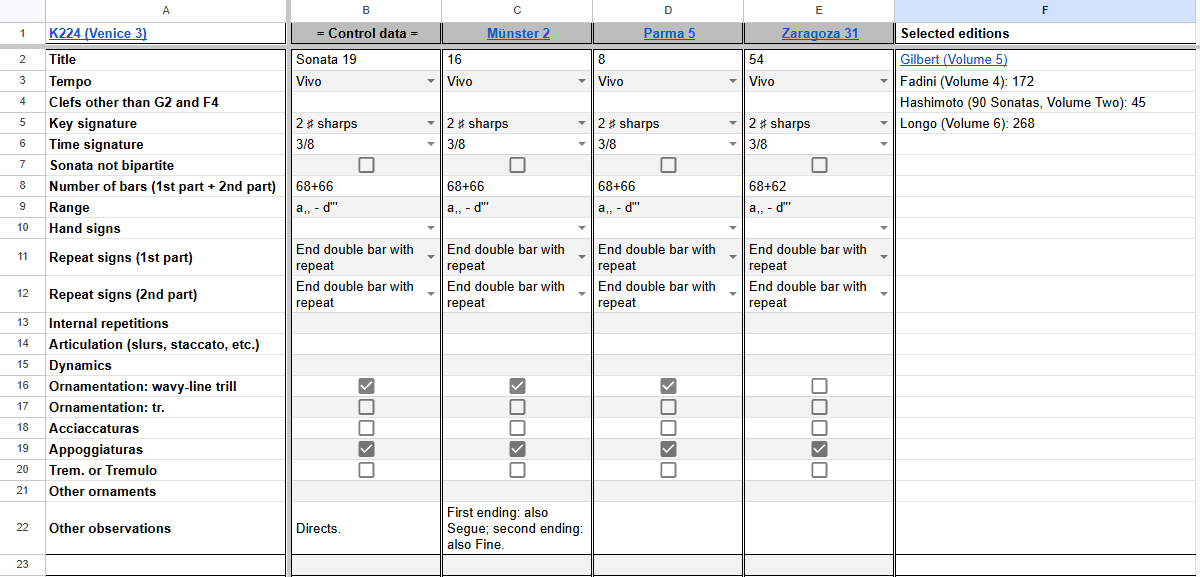
Figure 1. Example Header section from K224Collations are organised in single tabs on bespoke Google Sheets generated using our Roseingrave tool. Figure 1 shows an example of such a tab for K224. The Kirkpatrick number in the top left-hand corner (cell A1) contains a link to a PDF of the control of the relevant sonata (in this case Venice 3). The other columns (here columns C to E) contain links to PDFs of the eighteenth-century manuscripts and printed witnesses in which that sonata appears. The final column (here column F) lists information about selected editions in which this particular sonata can be found (in the case of Gilbert a link to the edition freely available on IMSLP is provided).
Our Google Sheets tabs have two sections: Header and Bars.
- The Header section has a number of fields which relate to the piece as a whole. Some of the fields have drop-down menus, others have yes/no tick boxes and some require free text entry.
- The Bars section consists of one row for each bar in the control. We have compared each bar in the witness with the control. If they are the same, the cell is left empty; if they contain variants, these are recorded using our bespoke notation system.
Each witness was compared with the same control (‘collated’) and all metadata and substantive variants were recorded in the appropriate cells. By substantive we mean variants such as pitch (including the presence or absence of any accidentals); duration (including the presence or absence of rests and ties); the presence or absence of various types of ornamentation; and some other features, all of which are described in more detail below.
Header section
Most of the Header section is quite straightforward: this section contains some important metadata on the texts in the control and the other extant witnesses. Some of the fields contain dropdown boxes (e.g. Tempo and Key signature) or tick boxes (e.g. Ornamentation); the rest of the fields are free text entry (they are left empty if the particular field does not apply to the witness). For K224, we can see that all sources contain the tempo marking Vivo, the time signature 3/8 and the same range. However, Zaragoza 31 contains four fewer bars in the second part which may be evidence of a copying error or a different tradition.
Bars section
In the Bars section we use our bespoke notation system: a concise and mostly alphanumeric system which, unlike conventional apparatus, is fully machine-readable. An example of a typical variant is given in Figure 2:
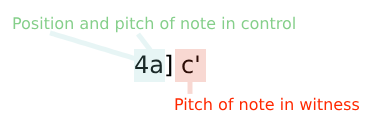
The first step to notating a variant is identifying its position in the bar. We count the notes (NB: not the beats) from the start of the bar, irrespective of voice, stave or hands. We treat ornaments (including grace notes) as part of the main note, tied notes as two separate notes and include rests as if they were notes. Effectively, we aim to count each separate vertical sound event in a bar. In some cases, vertical alignment of the notes may not be clear. If so, we can consult the Gilbert edition, as in the following example from K109:
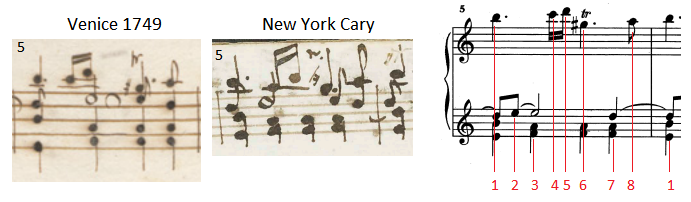
In Figure 3 we can see that Gilbert has adopted modern conventions for the notation of the ‘alto’ part, but the two bars will sound the same and the notes can be counted in the same way.
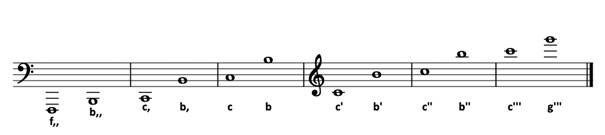
Pitches are referred to using the LilyPond pitch conventions (Figure 4).
Variant categories
To date, we have recorded 62 types of variants in 16 categories:
| Accents | Hand signs |
| Articulation | Ornaments |
| Bars (absent or added) | Other indications |
| Duration | Pitch |
| Dynamics | Rests |
| Expression | Slurs and ties |
| Fermatas | Stems |
| Grace notes | Tuplet signs |
Where applicable, most categories are subdivided in the following manner:
- Added variant (for example: witness contains a note which is not present in the control)
- Changed variant (for example: witness has different pitch from control)
- Removed variant (for example: pitch in control is absent in witness)
The removed variant subcategory is further divided into two types of removal. These two types of removal may appear to be superfluous but are in fact essential to other categories. For instance, if two trills are marked on position 1 the notation 1trill] 0 would not make it clear which of the two is absent; the notation 1c] -trill is much clearer. In cases where ambiguity is not an issue, the first notation is generally preferred. For consistency across the board, we follow the above notation style for all categories, with a few exceptions. Thus, for instance, the rests category has four possible variants:
| Type of variant | Notation | Meaning |
|---|---|---|
| Rests: added | 2] +r4 |
A crotchet rest has been added on the second position of the bar. |
| Rests: changed | 2r] 8 |
The rest on position 2 in the control is now a quaver rest in the witness. |
| Rests: removal (0) | 2r] 0 |
The rest on position 2 in the control is absent in the witness. |
| Rests: removal (-) | 3] -r4 |
There are multiple rests on position 3 in the control: one of these, specifically one of the crotchet rests, is absent in the witness. |
The following table shows some of the most common variants in the Texting Scarlatti project:
| Notation | Meaning |
|---|---|
9c] c, |
Witness note is different from control. |
9] +c,4 |
Crotchet c, present in witness but not in control. |
9c] 0 or 9] -c |
Note in control is not present in witness (NB: The second form may be preferred when the same note appears in both staves in the control, but only one is absent in the witness). |
9c] -trill or 9trill] 0 |
Trill in control is not present in witness (NB: We only use the second form if there is no chance of confusion). |
9c] 2 |
The c in the control is a minim in the witness (NB: We generally do not specify the value of the note in the control (unless, for example, both c2 and c4 exist)). |
1c] c, ; 2d] d, ; 3e] e, |
Run of three notes in witness different from control (note the spaces on either side of the semicolons). |
1c] -tie or 1tie] 0 |
Tie in control is not present in witness (NB: The same forms may also be used for slurs; we only use the second form if there is no chance of confusion). |
Further information
There are two further sections to our User Manual:
- Part two provides more information and examples of the metadata recorded in the Header section;
- Part three provides more information and examples of the variant notation used in the Bars section.
Examples of possible analyses using the Texting Scarlatti dataset are provided in the Analysis, part one and Analysis, part two pages. These pages also include guidance on how to analyse the dataset yourself.
Jasper van der Klis, October 2025