Compilation is a key concept in Scarlatti studies, because the vast majority of eighteenth-century witnesses survive not as single copies but as collections. That fact alone can tell us a great deal about the collectors’ tastes and preferences. With few exceptions, no two collections have the same contents, which means that they have been assembled from smaller groups of witnesses, often referred to as fascicles or booklets. Hence the over 3300 witnesses that we have identified survive in over 200 collections, an average of about 15 sonatas per collection. We have tracked down these witnesses by carefully reviewing and correcting a range of published sources, library catalogues and RISM.
The relationship between sonatas and collections—which sonatas appear in which collections in which order—is therefore fundamental to managing the corpus and understanding potential relationships between sources. We do this by means of a large spreadsheet which we call the Great Table. This consists of 211 columns and 558 rows and is available to consult and download in two formats: Microsoft Excel and a bespoke HTML version.
Sonata references
Although the canonical number of Scarlatti sonatas is 555, there are in fact 556 in Kirkpatrick’s catalogue and K8 and K33 exist in alternative versions. There are also some 78 attributed and attributable sonatas not in his catalogue and we have developed a ‘Kirkpatrick Supplement’ that uses KS numbers to ensure that they can be clearly identified in future. See the Sonatas section.
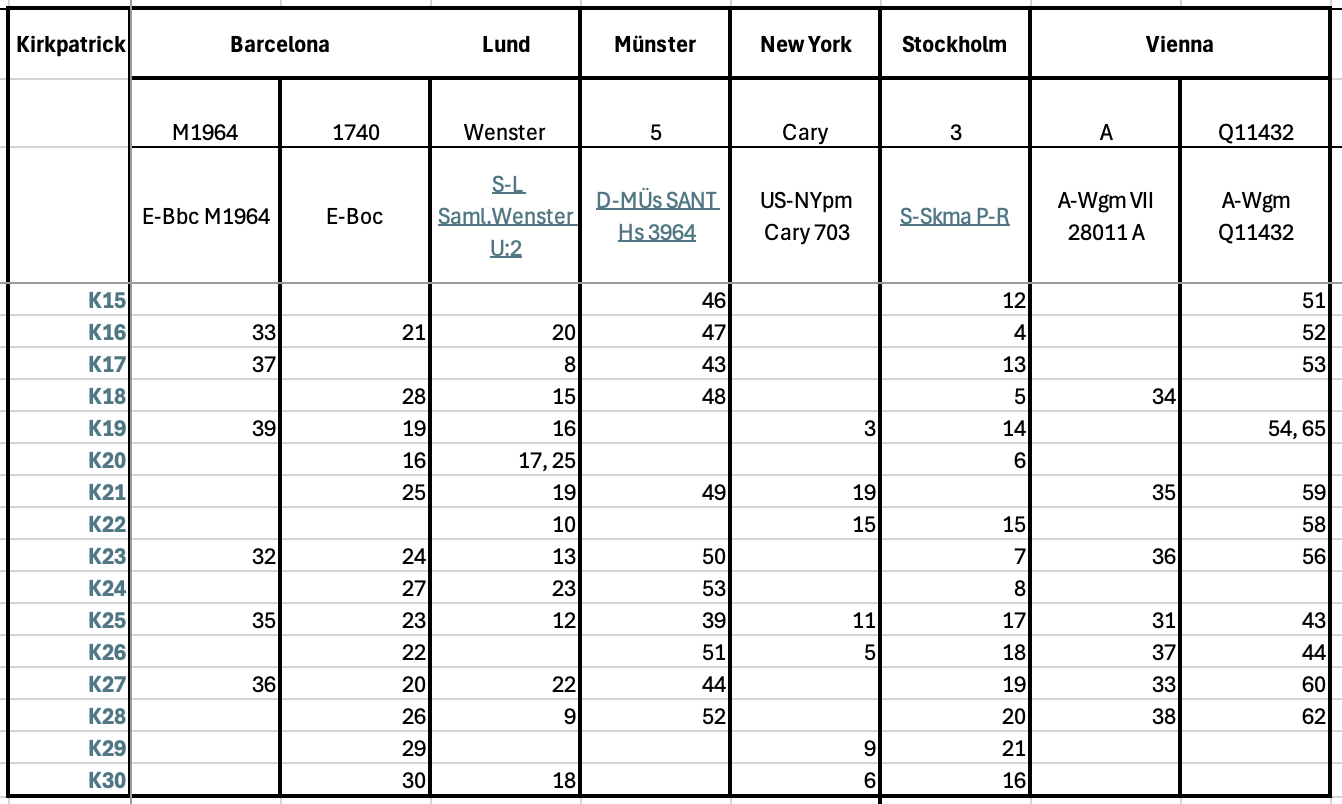
The Great Table can be sorted on any of the columns, which allows the corpus to be viewed from the perspective of that particular collection. Here is a screenshot that shows the order in which K15-30 appear in eight different manuscript copies of the Essercizi. Note that none of these witnesses transmits the sonatas in the published order.
Once we have identified and accounted for a collection we assign it an identifier or siglum, obtain a digital copy, index it and save the individual sonatas to folders in a private SharePoint site at Guildhall School and on a Google Drive. We are greatly indebted to the very large number of libraries and archives that have collaborated with us by making their collections available and allowing us to use them in this way. A very few collections have remained inaccessible for reasons ranging from force majeure to outright refusal. These are tinted red in the Great Table. Wherever possible, the principal collections have been examined in person by one of the core team.
Using the functionality of the Excel version in particular, we can generate charts that give an overview of the corpus as a whole. This simple bar chart shows the variation in the number of witnesses per sonata in the Essercizi (K1-30), what we call their ‘relative salience’:
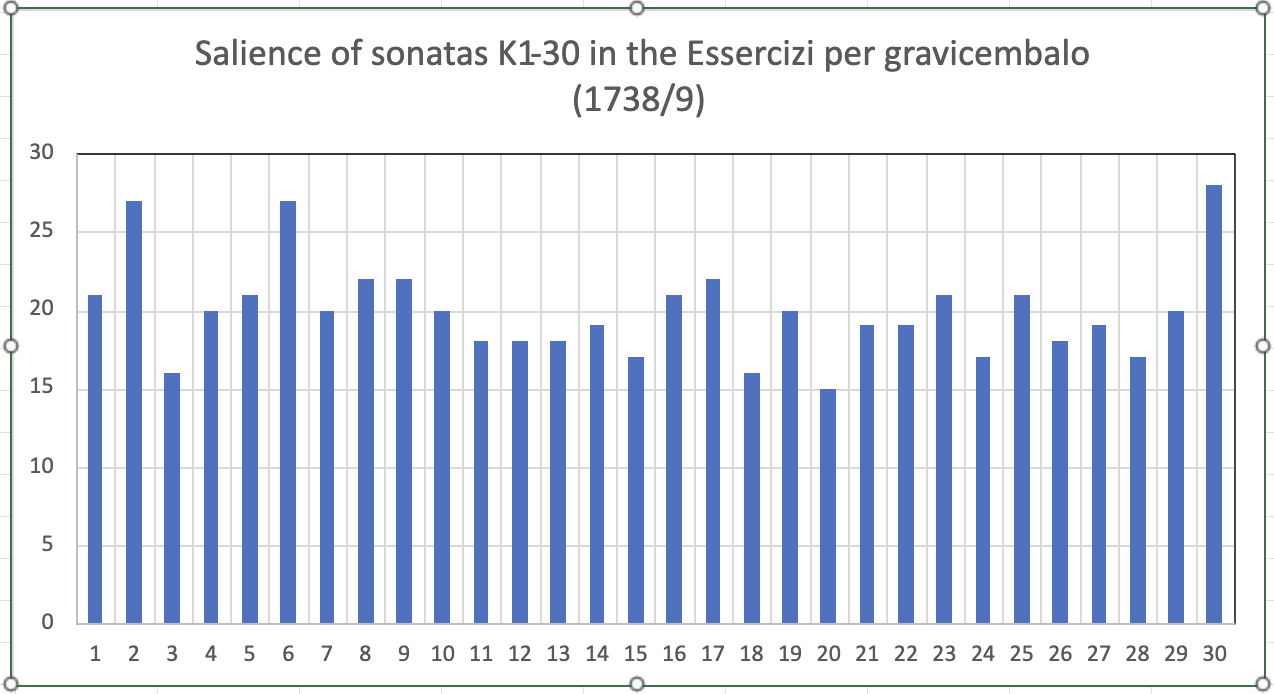
What is surprising here, perhaps—and might prompt the question why—is the fact that the Essercizi are Scarlatti’s first published collection of sonatas and, as such, might be expected to have circulated as a homogeneous set. In fact, as the chart shows, their salience ranges from 15 witnesses for K20 to 28 for K30, the ‘Cat’s Fugue’.
The following chart, also generated within Excel using a simple arithmetical procedure, tracks the highest and lowest notes in each sonata across the entire corpus. It shows a perceptible trend towards a larger compass, especially in the upper register, but there is considerable variation in both the bass and the treble, especially in the treble from about K360 onwards.
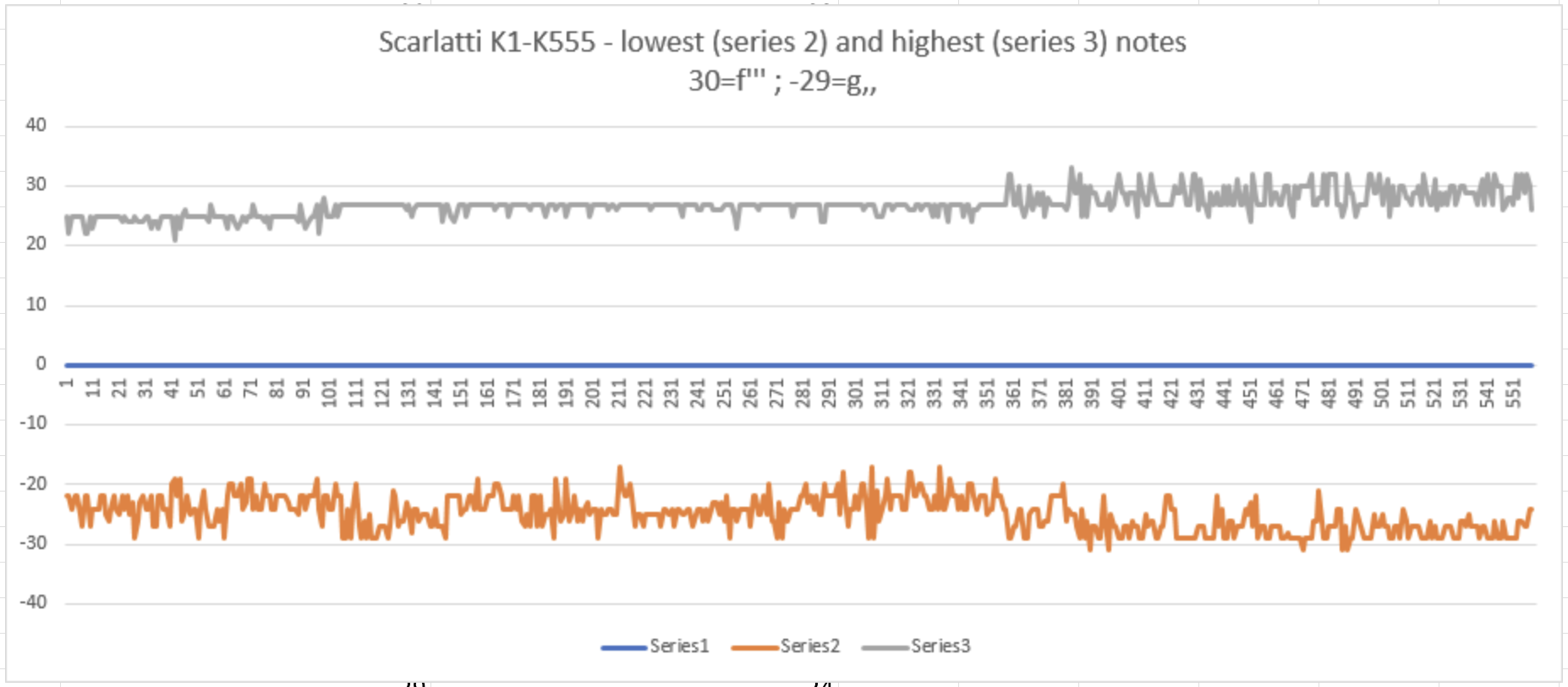
While this chart illustrates the general trend, similar charts for smaller groups of sonatas, combined with other data, can raise interesting questions about the homogeneity of particular collections.